Table of Contents
Hampshire County Courts, MA *

Residents of Hampshire County, just north of Springfield, need to understand how the court system works and how to access court records. People may need court records for research, or an employer may need them to determine whether a prospective employee has a criminal history. Landlords may use court records to check past evictions of future tenants. Residents may need to file paperwork for divorces, wills, or a personal injury lawsuit. That's why it's important to know how the Hampshire County Court system works.
How to Access Hampshire County Court Records

 Online Access
Because Massachusetts has a unified court system, its court cases are online via the MassGov portal. Not all court documents may be available, however, depending on how old the case is. Massachusetts has had its court cases available online since 2005. Every court in Massachusetts is online, but juvenile court proceedings are not publicly available.
 Alternative Online Options
Although court records are available online, the state records system can sometimes be confusing, especially when residents have missing or incomplete information about a court case. They may want to try a different option, such as CourtCaseFinder. This case aggregator can pull case records from any county in Massachusetts as well as nationwide, whether someone is looking for divorces, estates, or civil lawsuits. It is a great option for residents confused by the state courts portal.
 In-Person Requests
Sometimes, people may need to access court records in person. This is especially true if someone needs certified copies of court records for another court, a government agency, or a financial institution. Each court in Hampshire County has its own court clerk to handle the case records for its respective court. People who are not sure where to go to access court records can call the respective court before visiting. It is important to bring as much information about the case as possible to facilitate records access.
 Archived Records
Hampshire County was created over a hundred years before the Revolutionary War, so there are court records dating back more than 350 years. The first stop if a resident needs an archived court record is the Clerk of Court. There are also archived court records available at the UMass Amherst Special Collections and Archives as well as the Massachusetts Archives, managed by the Secretary of the Commonwealth.
Overview of the Hampshire County Court System

Massachusetts operates as a unified court system managed by the Supreme Judicial Court, with the Chief Justice serving as the head of the judicial system. The Supreme Judicial Court is the state's highest appeals court. An Appeals Court also hears appeals from trial courts in Massachusetts counties.
At the county level, Hampshire County has several trial courts. The county's highest trial court is the Superior Court, which hears major felony criminal cases and major civil cases over $50,000. The county's two District Courts hear misdemeanor cases and lower-level felony cases with penalties of up to five years in prison, as well as smaller civil suits and small claims lawsuits. Massachusetts also has Housing Courts to hear issues between landlords and tenants, evictions, and code enforcement issues. There are four Juvenile Courts in Hampshire County to hear nearly all cases involving juveniles, including juvenile delinquency and dependency cases. Probate and Family Courts handle child custody, child support, divorce, and other family-related cases. There are no Municipal Courts outside of the city of Boston.
Types of Courts in Hampshire County, Massachusetts
 Superior Court
The Superior Court in Hampshire County is the county's highest trial court. Superior Courts hear the county's most serious criminal and large civil cases.
Jurisdiction:
- Felony criminal cases with prison terms over 5 years, such as murder or armed robbery
- State, county, or municipal lawsuits
- Appeals from District, Family and Probate, Housing, or Juvenile Courts
- Property disputes not heard in Housing Court, such as land boundary or foreclosures
- Equity cases asking for law or policy changes rather than money damages
- Contract disputes
- Civil cases with damages over $50,000
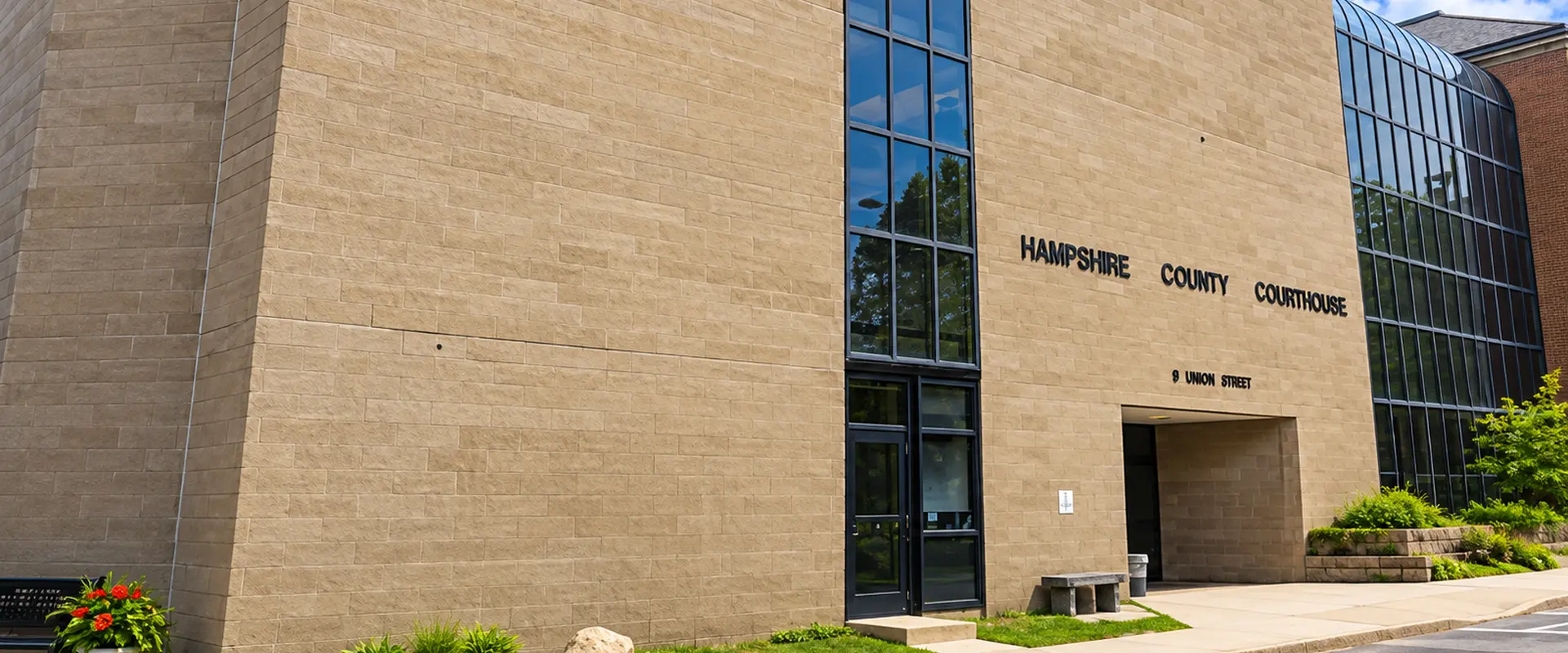
Primary Location: Hampshire County Courthouse, Northampton
 District Court
s in Massachusetts are the courts that most people in the state will interact with at some point during their lives. District Courts hear minor felony cases and civil lawsuits. Hampshire County has two District Courts: one in Eastern Hampshire serving the eastern half of the county and one in Northampton serving the western half.
Jurisdiction:
- All misdemeanor crimes
- Lesser felony crimes with a penalty of less than 5 years in prison
- Hearings to determine if a felony crime should be moved to Superior Court
- Warrant hearings (arrest warrants, search warrants)
- Traffic tickets and ordinance violations
- Small claims cases up to $7,000
- Civil cases under $50,000
- Protective orders
Primary Location: Eastern Hampshire District Court Building, Belchertown
 Housing Court
Hampshire County has one Housing Court. Housing courts hear both civil and criminal matters related to housing, usually matters involving rental housing rather than home ownership.
Jurisdiction:
- Evictions
- Small claims cases between landlord and tenant, such as security deposit disputes
- Lawsuits regarding personal injury or property damage in rental units
- Housing discrimination or unfair practices lawsuits
- Criminal or code enforcement cases regarding housing, such as sanitary or fire code violations
- Appeals, restraining orders, and injunctions against landlords or tenants
Primary Location: Commonwealth of Massachusetts Court System Building, Hadley
 Family and Probate Court
s in Massachusetts hear cases involving families in all stages of life. The most common cases deal with the dissolution of a marriage, but there are also cases involving wills and estates, as well as hearings regarding guardianship and conservatorship cases.
Jurisdiction:
- Divorce, division of property and alimony
- Child support and custody
- Paternity, adoption, and termination of parental rights
- Domestic violence protective orders
- Wills and estates
- Guardianships, conservatorships, and trusts
Primary Location: Atwood Professional Campus, Northampton
 Juvenile Court
s hear nearly all cases involving juvenile delinquency and dependency. The cases are heard by a judge rather than a jury. There are four Juvenile Courts in Hampshire County.
- Crimes committed by a juvenile under 18 years of age at the time of the crime
- Hearings to determine whether a serious felony committed by a juvenile should be moved to adult court
- CRA (Children Requiring Assistance) cases
- Adoption or termination of parental rights (concurrent with Family Court)
- Guardianship (concurrent with Family Court)
- Criminal charges for adults contributing to the delinquency of a minor
Primary Location: Belchertown, Greenfield, Hadley and Orange
How to File a Case in Hampshire County

Filing a court case in Hampshire means paying attention to court procedures, because failing to follow them can delay or dismiss a case. Here are the steps to filing a civil case correctly.
 Step 1: Choose the Correct Court
The first step in filing a case correctly is choosing the right court. Residents need to be sure they understand where to file the case, since Hampshire County has several court locations. In general, civil cases worth more than $50,000 are filed in Superior Court, and civil cases worth less than $50,000 are filed in District Court. Landlord-tenant civil issues are filed in Housing Court. File family law or probate cases with the Family and Probate Court. Residents unsure where to file can check with the appropriate Court Clerk.
 Step 2: Complete Required Forms
All required court forms in Massachusetts can be found online using the Court Forms page on the MassGov website. Be sure to complete all required forms before filing. Residents who have trouble completing their court forms can ask the appropriate Court Clerk for help.
 Step 3: File the Case
Hampshire County residents can file court cases online or in person using the eFileMA platform, which works for all courts in the state. Certain sensitive cases, such as guardianship or conservatorship, may not be available to file online. Check with the appropriate Court Clerk before filing sensitive cases to determine whether it can be filed online or must be filed in person. Attorneys must file cases online.
 Step 4: Pay Filing Fees
Paying filing fees in Hampshire County is not difficult, whether online or in person. If the paperwork has been filed online, residents must pay at the time of filing with a credit or debit card. Court Clerks allow residents who file in person to pay with cash, checks, money orders, and debit or credit cards. People who cannot afford to pay the filing fees can file a waiver with the court.
 Step 5: Serve the Other Party
Massachusetts law requires that residents who file a civil lawsuit notify the other party of the lawsuit. The law requires a sheriff's deputy or constable to serve the paperwork. While a government official must serve the initial paperwork, the law does not require service for subsequent filings, and additional paperwork can be mailed to the defendant. Return the Service of Process form to the court after the defendant has been served.
 Step 6: Monitor the Case
Once the case is filed, Hampshire County residents should monitor their cases for updates on hearings, calendar changes, or requests for additional documentation. They have a few options for checking their cases: They can check case progress online via eFileMA or the MassGov website, visit the Court Clerk in person, or call.
Hampshire County Courthouse Directory
Hampshire County Courthouse (Superior Court, Northampton District Court,
Northampton
Address: 15 Gothic St., Northampton, MA 01061
Phone: (413) 584-7400
Website: Hampshire County Courts
Eastern Hampshire District Court Building (Eastern Hampshire District Court,
Belchertown
Address: 205 State St., Route 202, Belchertown, MA 01007
Phone: (413) 213-7610
Website: Hampshire County Courts
Commonwealth of Massachusetts Court System Building (Western Housing Court-Hadley Section, Hadley Juvenile Court)
Hadley
Address: 116 Russell St., Hadley, MA 01035
Phone: (413) 584-7686
Website: Hampshire County Courts
Atwood Professional Campus (Family and Probate Court)
Northampton
Address: 15 Atwood Dr., Northampton, MA 01060
Phone: (413) 586-8500
Website: Hampshire County Courts
Juvenile Courts
Belchertown Juvenile Court
Address: 205 State St., Belchertown, MA 01007
Phone: (413) 323-4056
Greenfield Juvenile Court
Address: 43 Hope St., Greenfield, MA 01302
Phone: (413) 775-0014
Hadley Juvenile Court
Address: 116 Russell St., Route 9, Hadley, MA 01035
Phone: (413) 584-7686
Orange Juvenile Court
Address: 1 Court Square, Orange, MA 01364
Phone: (978) 544-5125
Legal and Self-Help Resources
Residents of Hampshire County need access to court and legal services, but for some people, this can be difficult. Here are some resources available to Hampshire County residents.
- Massachusetts has many resources available on its Self-Help page. There is information on self-filers, residents who want to represent themselves when filing small claims or family cases, as well as information on court structure, accessing court documents, court forms, and assistance information.
- The Massachusetts Hampshire Elder Law Program (HELP) has pro bono attorneys who help senior citizens in the county who qualify for income assistance with civil cases. Examples of cases attorneys can help with include housing discrimination, evictions, credit issues, probate, and family law cases.
FAQs
How do I search for a criminal case in Hampshire County?
Criminal cases can be found in District Court or in Superior Court. Misdemeanor cases are filed in District Court, while felony cases are in Superior Court. Traffic tickets are in District Court, and housing ordinance violations as well as criminal charges filed against a landlord are heard in Housing Court. All of these cases after 2005 can be found on the MassGov website.
Are court records public in Hampshire County?
Massachusetts law guarantees that most records in the state are public, but some exceptions apply. Juvenile cases are not public due to the age of the children involved; however, if a violent felony is moved to Superior Court, the case record becomes public. Judges can order documents or cases sealed.
Where can I find eviction records?
Eviction records for Hampshire County can be found in the Housing Court. Residents can access those cases by visiting the Housing Court in person to get records from the Housing Court Clerk, or they can get the files they need online on the MassGov website. They can also use a third-party records finder such as CourtCaseFinder, which pulls records from across the country.
The issues are with the court addresses.
Other Counties in Massachusetts
Table of Contents
